Are Your New Windows Actually Safe? What Australian Homeowners Need to Know
A 7 News report has renewed scrutiny on imported windows and doors entering the Australian market. Here is what compliance actually means — and what to check before any product goes into your home.
If you are renovating or building a new home, the windows and doors you choose are not just an aesthetic decision. They are a structural and safety one. A growing number of imported aluminium windows and doors are entering the Australian market at significantly reduced prices — and not all of them meet the minimum performance standards required under Australian law.
For homeowners, that matters. A window that cannot withstand Australian weather conditions, or that allows water penetration, is not just an inconvenience. It can cause lasting structural damage, mould growth inside wall cavities, and in serious cases, pose a direct safety risk to anyone nearby.
What Australian Standard AS 2047 Actually Requires
Every window and external glazed door installed in an Australian home must comply with AS 2047 — the national standard for windows and external glazed doors in buildings. This is not a guideline or a recommendation. It is a mandatory requirement under the National Construction Code (NCC).
AS 2047 sets minimum performance requirements across five areas:
- Wind load resistance — the window must not deflect or fail under the wind pressures expected in your area
- Water penetration resistance — no leaks at the required test pressure
- Air infiltration — limits on unwanted air movement, which directly affects energy efficiency
- Structural strength — the frame must not fail under ultimate wind load testing
- Operating force — opening sashes must open and close without excessive effort
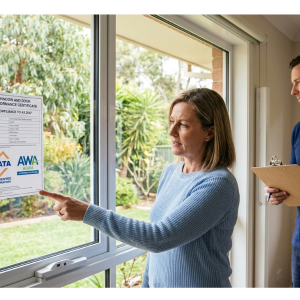
Every compliant product must carry a Performance Label — typically found on the inside of the window frame — showing its wind and water ratings in Pascals. The manufacturer must also be able to provide a Certificate of Compliance backed by testing from a NATA-accredited laboratory.
Why Imported Products Are Under Scrutiny
Australia has seen a marked increase in imported building materials in recent years, including aluminium windows and doors sold at significantly lower price points than locally manufactured alternatives — in some cases, around half the price.
A recent 7 News report highlighted independent testing of imported aluminium window and door products finding a number of them failing to meet AS 2047 requirements — particularly around water penetration resistance and structural performance under wind load.
The consequences are not abstract. Water penetrating through a failed window seal does not stop at the sill. It works into wall cavities, soaks into structural elements, and creates the conditions for mould. A door panel or window that fails under strong wind load becomes a physical hazard to anyone nearby.
Part of the problem is that builders, developers and certifiers often do not scrutinise window compliance as closely as other structural elements — until something goes wrong. By then, rectification is expensive, and the homeowner is the one left managing the damage.
Three Things to Check Before Any Window Is Installed
Whether you are working with a builder or sourcing windows directly, ask for these three things before any product goes into your home.
1. The AS 2047 Performance Label
Every compliant window must have a Performance Label affixed to the inside of the frame, showing its wind and water ratings in Pascals. If the supplier cannot show you one, treat that as a red flag.
2. A Certificate of Compliance with NATA-accredited test report
This document confirms the product has been tested to AS 2047. The testing laboratory should be NATA-accredited — meaning its testing methods are independently verified. Ask specifically for the test report, not just a compliance declaration from the manufacturer.
3. Industry accreditation from AWA or AGWA
Members of the Australian Window Association (AWA) or the Australian Glass and Window Association (AGWA) are subject to annual compliance audits. Products from accredited members carry an additional layer of accountability that products sourced through less-established importers typically do not.
- ✔ Performance Label on the window frame (wind and water ratings in Pascals)
- ✔ Certificate of Compliance from the manufacturer
- ✔ NATA-accredited test report on request
- ✔ Manufacturer holds AWA or AGWA accreditation
Why uPVC Windows Are Worth Considering
Much of the current scrutiny centres on imported aluminium products. uPVC (unplasticised polyvinyl chloride) windows represent a different category — and one with a strong track record in demanding climates across Europe, the UK, and increasingly across Australian homes.
uPVC frames do not corrode, do not conduct heat the way aluminium does, and offer superior thermal performance. When manufactured to AS 2047 and installed correctly, uPVC windows provide excellent weather sealing, acoustic performance, and long-term durability — without the maintenance demands of timber or the thermal bridging associated with standard aluminium frames.
For homeowners questioning the quality of imported aluminium products, uPVC is worth understanding as an alternative — particularly for full-frame replacement, where you are making a decision intended to last decades.
Price Is Not the Only Number That Matters
The appeal of lower-cost imported windows is understandable, particularly when renovation budgets are under pressure. But windows and doors are not a category where cutting corners pays off. A non-compliant product may not be identified at installation. The problems emerge later — through a leaking frame in the first heavy rain, through energy bills that never improve, or through a structural failure that causes damage or injury.
The right question is not “what is the cheapest window available?” It is “what documentation does this manufacturer provide, and can I verify it independently?”
If your supplier cannot answer that clearly, it is worth looking at your options.
Ecostar Double Glazing manufactures and installs uPVC double glazed windows and doors for Australian homes. All products are manufactured to AS 2047 and backed by full compliance documentation.
Frequently Asked Questions
Are all windows sold in Australia required to meet AS 2047?
Yes. All windows and external glazed doors installed in the external wall of a building must comply with AS 2047 under the National Construction Code. This applies regardless of the material — aluminium, uPVC, or timber.
How do I know if windows I’ve already had installed are compliant?
Check the inside of the window frame for a Performance Label showing wind and water ratings. If no label is present, ask your builder or supplier for the Certificate of Compliance and test report. If they cannot provide one, contact the Australian Window Association for guidance.
What is the difference between uPVC and aluminium windows?
Both can be manufactured to meet AS 2047. The key differences are thermal performance (uPVC does not conduct heat the way aluminium does), maintenance (uPVC does not corrode or require repainting), and long-term energy efficiency. uPVC windows typically deliver better insulation and lower lifetime maintenance costs.
What does full-frame replacement mean?
Full-frame replacement means removing the entire existing window — frame, sill, and all — and installing a new window system from scratch. This is different from a glass-only retrofit, which inserts new glass into an existing frame. Full-frame replacement is the only way to ensure the new window meets current AS 2047 standards as a complete, tested system.
What is a NATA-accredited laboratory?
NATA stands for the National Association of Testing Authorities. A NATA-accredited laboratory has been independently assessed to confirm its testing methods, equipment, and competency meet recognised standards. When a window manufacturer references NATA-accredited testing, it means the compliance testing has been independently verified — not just self-declared.
Can I check if a window manufacturer is AWA or AGWA accredited?
Yes. Both the Australian Window Association (AWA) and the Australian Glass and Window Association (AGWA) maintain member directories on their websites. You can search for your supplier by name before committing to a purchase.
Share
More News
Double Glazing or Secondary Glazing: What’s the Difference?
Bushfire Season 2026 Is Starting Earlier – Is Your Home’s Glazing Ready?
Condensation on Windows: Why It Happens and How to Stop It
Heading to the 2026 Melbourne Home Show? Come and See Ecostar Double Glazing